🚚 FREE SHIPPING on orders over $99•✓ 30-Day Money Back Guarantee•⭐ Serving Okanagan Since 1994•🚚 FREE SHIPPING on orders over $99•✓ 30-Day Money Back Guarantee•⭐ Kelowna's Favorite Vacuum Store since 1994
Central Vacuum Suction and Airflow: What Actually Drives Cleaning Performance
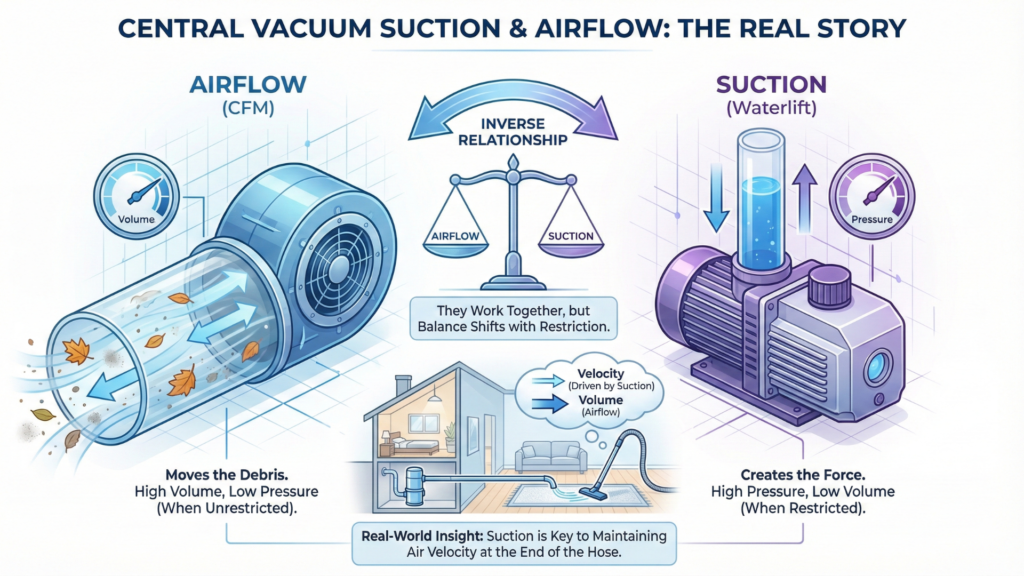
In our previous article on airwatts, we explained why the most popular vacuum performance metric is misleading. But if airwatts aren’t the right way to evaluate a central vacuum, what is? The answer comes down to understanding the two fundamental forces at work in every system: central vacuum suction and airflow. They work together, but in a real-world installation, one matters significantly more than the other.
This article breaks down how each force works, why they have an inverse relationship, and what engineering tests reveal about their actual impact on end-of-hose performance.
What Is Airflow in a Central Vacuum?
Airflow is measured in CFM — cubic feet per minute — and it tells you how much air the motor can move. Think of it as the volume of air flowing through the system at any given moment.
In the context of central vacuum suction and airflow, airflow is the force that physically carries dirt and debris from your floor, through the hose, through the PVC plumbing, and into the collection canister. Without sufficient airflow, debris simply won’t move regardless of how strong the suction is.
The analogy is autumn leaves blowing across a parking lot. It’s the movement of air — the airflow — that carries them.
What Is Suction in a Central Vacuum?
Suction — also called vacuum or waterlift — is measured in inches of waterlift. It tells you the maximum pulling force the motor can generate. This is determined by how high the motor can pull a 2-inch column of water vertically, hence the name.
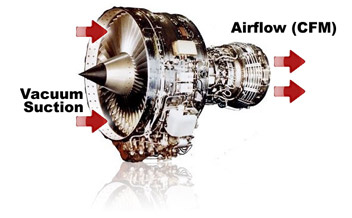
If airflow is the wind that carries the leaves, suction is the atmospheric pressure difference that creates the wind in the first place. It’s the driving force behind the movement and velocity of air through your entire system.
Understanding the relationship between central vacuum suction and airflow is the key to evaluating real performance.
The Inverse Relationship Between Suction and Airflow
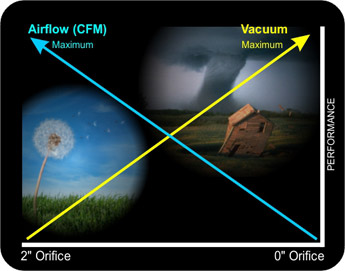
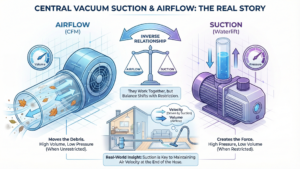
Here’s a critical concept: central vacuum suction and airflow have an inverse relationship on the motor’s performance curve.
When the system is wide open with no restriction, airflow is at its maximum — but suction is at its weakest. When the system is completely sealed with no air movement, suction is at its maximum — but there’s zero airflow.
Your central vacuum never operates at either extreme. It operates somewhere in between, at a point determined by the total restrictions in your system: the filter, the plumbing runs, the hose length, and whatever cleaning tool you’re using at the end.
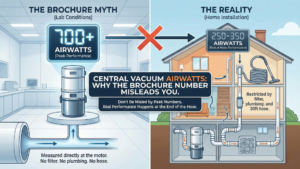
The term airwatts was created to find the sweet spot where central vacuum suction and airflow coexist most efficiently. But as we’ve discussed, that sweet spot is measured at the motor under ideal conditions — not at the end of a real-world hose.
Why Suction Matters More Than Airflow in Your Home
In a central vacuum system with typical household restrictions — plumbing, filtration, a 30-foot hose — suction plays the greater role in actual end-of-hose performance. This is the most important insight in understanding central vacuum suction and airflow.
Why? Because all those restrictions consume airflow. The longer your hose, the more plumbing between the inlet and the motor, the more restrictive your filter — the more airflow is reduced before it reaches the cleaning tool. Suction is what overcomes those restrictions and maintains usable airflow and air velocity where it matters.
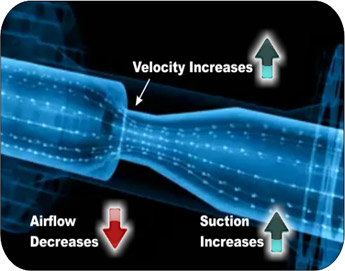
Think of your garden hose. The more water pressure at the source, the stronger the flow at the end — even over long distances. Place your thumb over the opening, and the velocity increases dramatically. That’s pressure (suction) doing the work, amplified by the Venturi effect.
A central vacuum with strong suction potential works the same way. When you use a crevice tool or narrow nozzle, you’re reducing the orifice — and a motor with higher suction responds with a greater increase in air velocity.
The Ametek/Lamb Engineering Test
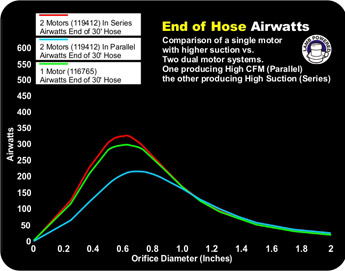
Ametek/Lamb engineers conducted a landmark experiment to demonstrate which force — suction or airflow — contributes more to real-world cleaning performance. They set up three systems and measured actual end-of-hose performance through a 30-foot hose:
System One (Baseline): A single motor serving as the control measurement.
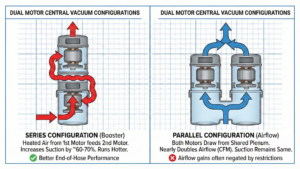
System Two (Boosted Suction): Two motors configured in series. This setup didn’t change airflow but increased suction by approximately 70%.
System Three (Boosted Airflow): Two motors configured in parallel. This setup didn’t change suction but nearly doubled airflow.
The results were clear and dramatic.
The system that boosted airflow (System Three) had the lowest end-of-hose airwatt performance. Despite nearly doubling the airflow at the motor, the gains were almost entirely negated by the restrictions of the hose and plumbing.
The system that boosted suction (System Two) had the highest end-of-hose performance — significantly outperforming both the baseline and the airflow-boosted system.
This test demonstrates that when evaluating central vacuum suction and airflow, suction potential is the more reliable indicator of real-world cleaning capability.
The Role of Air Velocity
Even when total airflow volume is reduced by restrictions, a motor with strong suction can maintain high air velocity through those restrictions. And velocity is what actually picks up and moves debris.
Consider the difference between a gentle breeze and a tornado. Both involve moving air, but the velocity makes all the difference. In a vacuum system, higher velocity at the cleaning tool means better cleaning performance — even if the total CFM isn’t dramatically higher than a competing system.
A typical bathroom exhaust fan can produce airflow comparable to a central vacuum motor’s output. But an exhaust fan generates almost no suction. It couldn’t overcome the resistance of a central vacuum’s plumbing and hose — so it would produce zero usable airflow at the end of the line. This illustrates perfectly why airflow alone doesn’t tell the story. Without suction to push air through restrictions, even high CFM numbers are meaningless.
How to Use Central Vacuum Suction and Airflow Specs When Shopping
When evaluating systems, don’t fixate solely on CFM or airwatts. Pay close attention to the sealed vacuum (maximum waterlift) specification. This number represents the motor’s suction potential — its ability to overcome the restrictions present in every real-world installation.
The higher the sealed vacuum potential, the better the motor can maintain performance through long hose runs, restrictive tools, and filter buildup. It’s a far more practical indicator of end-of-hose cleaning performance than peak airwatts or maximum CFM.
When combined with knowledge of motor type and size, sealed vacuum potential gives you a much more accurate picture of what a central vacuum will actually deliver in your home.
Frequently Asked Questions About Central Vacuum Suction and Airflow
What is more important in a central vacuum — suction or airflow? Both are essential, but in a real-world installation with hoses, plumbing, and filters, suction (waterlift) plays the greater role in end-of-hose performance. Airflow gains at the motor are largely consumed by system restrictions.
What is waterlift in a central vacuum? Waterlift measures the maximum suction force a motor can generate. It’s determined by how high the motor can pull a 2-inch column of water vertically, expressed in inches. Higher waterlift means stronger suction potential.
How much CFM does a central vacuum need? There’s no single CFM number that guarantees good performance, because real-world airflow depends on system restrictions. A motor with high sealed vacuum (suction) will deliver better end-of-hose airflow than a motor with higher raw CFM but weaker suction.
What is the Venturi effect in a vacuum? The Venturi effect describes how air velocity increases when forced through a smaller opening. In a central vacuum, using a crevice tool or narrow nozzle reduces the orifice, and a motor with strong suction responds with a significant increase in air velocity and cleaning power.
Why doesn’t doubling airflow double cleaning performance? Because airflow gains are absorbed by the restrictions of the hose, plumbing, and filter before reaching the cleaning tool. Ametek/Lamb testing showed that a system with doubled airflow actually had the worst end-of-hose performance among three configurations tested.
When shopping for a central vacuum, most conversations focus on motors and performance numbers. But central vacuum filtration deserves just as much attention. Your filter
In our previous article on airwatts, we explained why the most popular vacuum performance metric is misleading. But if airwatts aren’t the right way to
If you’ve spent any time researching central vacuums, you’ve almost certainly come across the term “airwatts.” It’s the single most commonly cited performance metric in
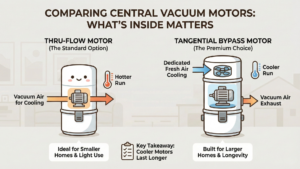
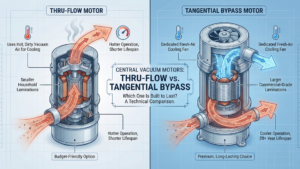
Knowing the difference between Thru-Flow and Tangential Bypass motors is a great start — but comparing central vacuum motors properly means going deeper. Motor type
To provide the best experiences, we use technologies like cookies to store and/or access device information. Consenting to these technologies will allow us to process data such as browsing behavior or unique IDs on this site. Not consenting or withdrawing consent, may adversely affect certain features and functions.
Functional
Always active
The technical storage or access is strictly necessary for the legitimate purpose of enabling the use of a specific service explicitly requested by the subscriber or user, or for the sole purpose of carrying out the transmission of a communication over an electronic communications network.
Preferences
The technical storage or access is necessary for the legitimate purpose of storing preferences that are not requested by the subscriber or user.
Statistics
The technical storage or access that is used exclusively for statistical purposes.The technical storage or access that is used exclusively for anonymous statistical purposes. Without a subpoena, voluntary compliance on the part of your Internet Service Provider, or additional records from a third party, information stored or retrieved for this purpose alone cannot usually be used to identify you.
Marketing
The technical storage or access is required to create user profiles to send advertising, or to track the user on a website or across several websites for similar marketing purposes.