🚚 FREE SHIPPING on orders over $99•✓ 30-Day Money Back Guarantee•⭐ Serving Okanagan Since 1994•🚚 FREE SHIPPING on orders over $99•✓ 30-Day Money Back Guarantee•⭐ Kelowna's Favorite Vacuum Store since 1994
Central Vacuum Motors: Why the Motor Type Matters More Than the Specs
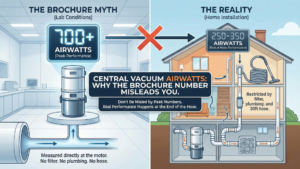
When it comes to choosing a central vacuum, everything starts with the motor. Central vacuum motors are the heart of the system — they determine performance, longevity, and ultimately what you’re paying for. Yet most shoppers never think to ask what kind of motor is inside the unit they’re considering, relying instead on misleading specs like airwatts.
This article explains the two main types of central vacuum motors, how they work, and why one is engineered to last dramatically longer than the other.
How Thru-Flow Central Vacuum Motors Work
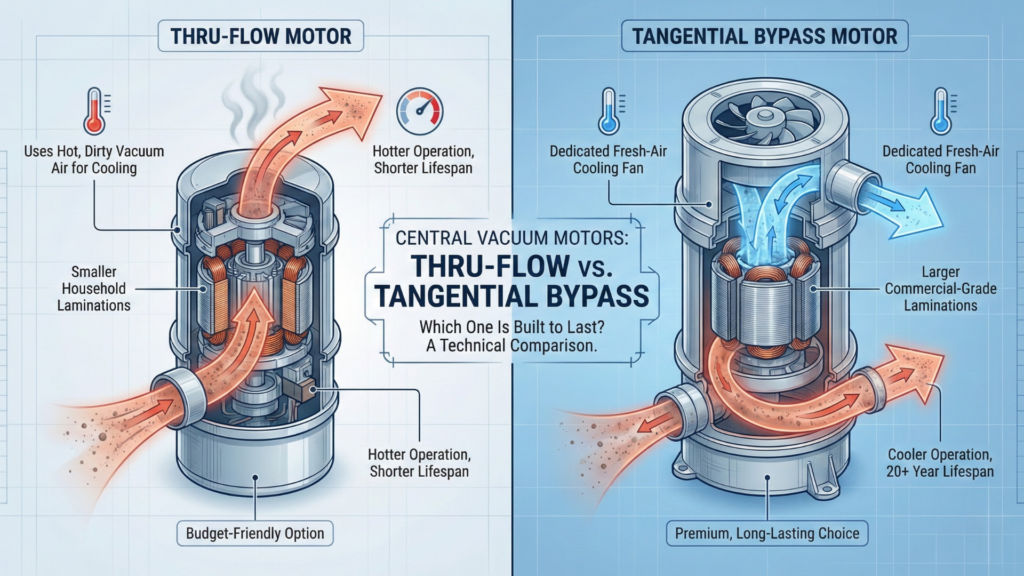
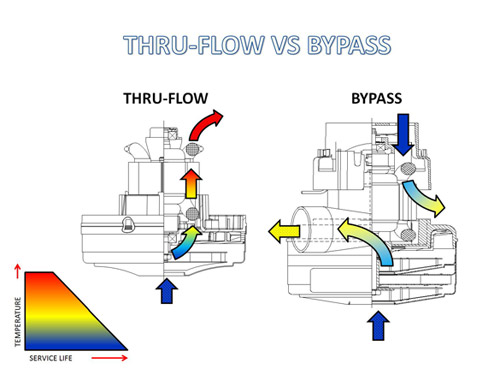
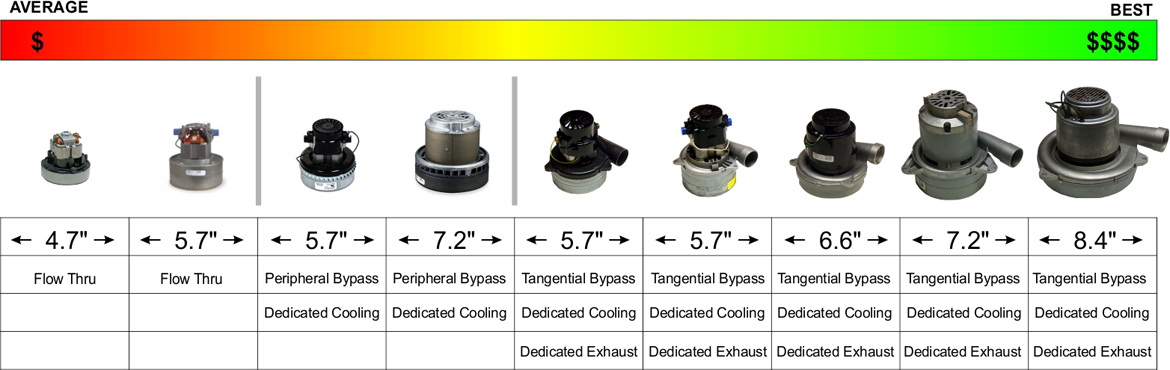
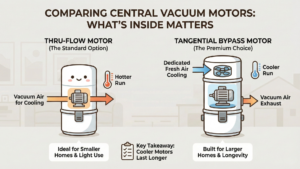
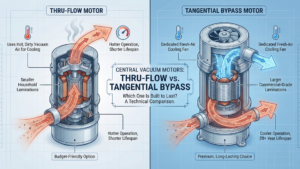
Thru-Flow motors are the more affordable of the two central vacuum motors on the market. They pull vacuumed air directly through the motor housing, using that same air to cool the internal components. There is no dedicated cooling fan — the vacuumed air does double duty as both the cleaning medium and the coolant.
This design has several implications for performance and lifespan:
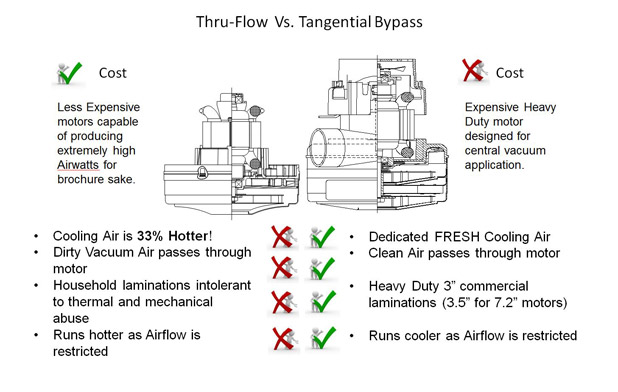
The vacuuming process has already heated the cooling air before it reaches the motor, making it on average 33% hotter than ambient room temperature. That same air, despite passing through a filter, still carries fine dust particles directly over the motor’s internal working components. The motor laminations — the stacked metal layers forming the motor’s core — are smaller and carry a household-use rating, making them less tolerant of the thermal stress that comes with heavy vacuuming.
Here’s an important engineering detail: with any central vacuum motor, the more you restrict the airflow, the faster the motor runs. When you attach a crevice tool or the hose gets kinked, a Thru-Flow motor speeds up and gets hotter — because there’s less air flowing through to cool it. A completely sealed vacuum with zero airflow is essentially deadly for a Thru-Flow motor.
When Thru-Flow Central Vacuum Motors Make Sense
None of this means Thru-Flow central vacuum motors are bad. They deliver solid performance at a lower price point and work well in the right situation:
Your home is a smaller space or condo (under 3,000 square feet). Pets and young children aren’t generating heavy dirt and debris. Long-term ownership isn’t a priority, so minimizing the upfront investment makes sense. And your cleaning routine is light and infrequent, meaning the motor won’t face sustained heavy loads.
A manufacturer might rate a Thru-Flow system to clean a home of 12,000 square feet — and technically it can. But should you expect it to last as long as a Tangential Bypass system in that same home? No.
How Tangential Bypass Central Vacuum Motors Work
Tangential Bypass motors take a fundamentally different approach to cooling and air management, which is why industry professionals regard them as the premium choice among central vacuum motors.
Instead of using vacuumed air to cool the motor, a Tangential Bypass motor has a dedicated fresh-air cooling fan mounted on top. This fan draws in clean, room-temperature air to cool the armature independently of the vacuuming process.
The dirty vacuumed air, meanwhile, bypasses the internal motor components entirely. The motor exhausts it tangentially — directing it away through a separate path — so heated, contaminated air never comes into contact with crucial motor parts.
Why Tangential Bypass Motors Are Superior
The engineering advantages of Tangential Bypass central vacuum motors come down to four key differences:
Cooler operation. The dedicated cooling fan uses fresh ambient air instead of heated vacuum air, so a Tangential Bypass motor runs significantly cooler. Cooler motors last longer — it’s as simple as that. Heat is the number one killer of electric motors, and this design directly addresses that.
Cleaner internal components. Dirty air never passes over the motor’s working parts. This eliminates one of the primary causes of motor wear and failure in Thru-Flow designs — fine dust contamination on the armature, brushes, and laminations.
Heavy-duty laminations. Tangential Bypass motors use larger, commercial-grade laminations. A 5.7-inch Tangential motor uses 3-inch commercial-grade laminations, with even larger laminations on 7.2-inch and 8.4-inch models. These can handle thermal and mechanical stress that would degrade a Thru-Flow motor’s smaller, household-rated laminations.
They run cooler under restriction — not hotter. This is the most counterintuitive advantage. When airflow is restricted in a Tangential Bypass system — by a crevice tool, a kinked hose, or natural plumbing resistance — the motor speeds up. But the cooling fan links mechanically to the motor and spins at the same RPM, so cooling also increases. A Tangential Bypass motor runs cooler when working harder. That’s the exact opposite of a Thru-Flow motor, and it’s a significant factor in extending motor life.
The Price Difference Between Central Vacuum Motors
Tangential Bypass motors cost significantly more. A large 8.4-inch Tangential Bypass motor can easily cost four times more than a comparable Thru-Flow. The retail price of the central vacuum unit should reflect that cost difference.
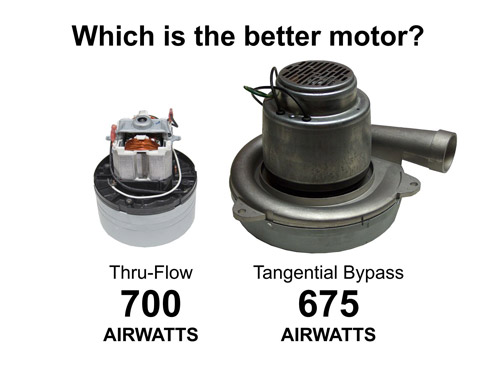
Unfortunately, many well-known brands use smaller, less expensive Thru-Flow motors in units with high retail prices, relying on impressive airwatt numbers to justify the cost. Most consumers shop on airwatts and rarely ask about the motor type, so few people ever challenge this practice.
If a manufacturer isn’t telling you what type of motor they’re using, ask to see what’s inside. It’s your money, and you deserve to know what motor is in the unit you’re paying for. If they won’t disclose it, assume it’s the less expensive option.
Central Vacuum Motors: Which Should You Choose?
The right motor depends on your home, your family, and how you use your vacuum:
Choose a Thru-Flow motor if you have a smaller home or condo, clean infrequently, don’t have pets or children, or want to minimize upfront cost. Just make sure the retail price reflects the motor inside.
Choose a Tangential Bypass motor if you clean frequently, have a larger home (3,000+ square feet), have a growing family with pets or children, or want a system built to last 20+ years. The higher upfront investment pays for itself in longevity and consistent performance.
As Benjamin Franklin once said, the bitterness of poor quality remains long after the sweetness of low price is forgotten. When it comes to central vacuum motors, that couldn’t be more true.
Frequently Asked Questions About Central Vacuum Motors
What type of motor is best for a central vacuum? Tangential Bypass motors are the superior choice for most homes. They run cooler, keep dirty air away from internal components, use commercial-grade laminations, and have a significantly longer service life than Thru-Flow motors.
How long do central vacuum motors last? A Tangential Bypass motor in a well-maintained system can last 20 years or more. Thru-Flow motors have a shorter lifespan, particularly under heavy use in larger homes.
Are Thru-Flow motors bad? No. Thru-Flow central vacuum motors deliver solid performance at a lower price. They’re a good choice for smaller homes, condos, or light-use scenarios. They’re simply not as durable or robust as Tangential Bypass motors for demanding applications.
Why do some expensive central vacuums still use Thru-Flow motors? Because Thru-Flow motors cost a fraction of what Tangential Bypass motors cost, and most consumers shop on airwatt numbers rather than motor type. This allows some manufacturers to charge premium prices while using budget-tier motors.
What is the biggest central vacuum motor available? Ametek/Lamb manufactures the largest motor available — the 8.4-inch Tangential Bypass with Infinity brush technology. It remains the industry’s most robust motor option for residential central vacuum systems.
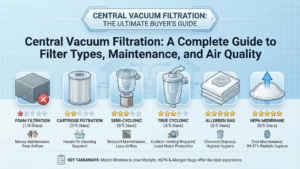
When shopping for a central vacuum, most conversations focus on motors and performance numbers. But central vacuum filtration deserves just as much attention. Your filter
In our previous article on airwatts, we explained why the most popular vacuum performance metric is misleading. But if airwatts aren’t the right way to
If you’ve spent any time researching central vacuums, you’ve almost certainly come across the term “airwatts.” It’s the single most commonly cited performance metric in
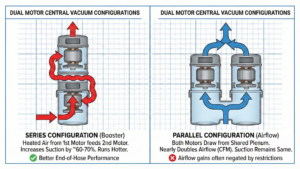
Knowing the difference between Thru-Flow and Tangential Bypass motors is a great start — but comparing central vacuum motors properly means going deeper. Motor type
To provide the best experiences, we use technologies like cookies to store and/or access device information. Consenting to these technologies will allow us to process data such as browsing behavior or unique IDs on this site. Not consenting or withdrawing consent, may adversely affect certain features and functions.
Functional
Always active
The technical storage or access is strictly necessary for the legitimate purpose of enabling the use of a specific service explicitly requested by the subscriber or user, or for the sole purpose of carrying out the transmission of a communication over an electronic communications network.
Preferences
The technical storage or access is necessary for the legitimate purpose of storing preferences that are not requested by the subscriber or user.
Statistics
The technical storage or access that is used exclusively for statistical purposes.The technical storage or access that is used exclusively for anonymous statistical purposes. Without a subpoena, voluntary compliance on the part of your Internet Service Provider, or additional records from a third party, information stored or retrieved for this purpose alone cannot usually be used to identify you.
Marketing
The technical storage or access is required to create user profiles to send advertising, or to track the user on a website or across several websites for similar marketing purposes.