🚚 FREE SHIPPING on orders over $99•✓ 30-Day Money Back Guarantee•⭐ Serving Okanagan Since 1994•🚚 FREE SHIPPING on orders over $99•✓ 30-Day Money Back Guarantee•⭐ Kelowna's Favorite Vacuum Store since 1994
Dual Motor Central Vacuum: Are Two Motors Always Better Than One?
If one motor is good, two must be better — right? It’s a logical assumption, and it’s one of the most common questions when shopping for a central vacuum. But the reality of a dual motor central vacuum is more complicated than doubling up. Depending on the configuration and the motors being used, a two-motor system can actually perform worse than a single high-quality motor.
This article explains the two ways dual motors can be configured, what the engineering data says about each, and when a dual motor central vacuum genuinely makes sense.
Before You Compare: What Motors Are Inside?
Before evaluating any dual motor central vacuum, the first question should be: what motors are they using?
Some manufacturers use dual-motor setups not because two motors deliver superior performance, but because they’re pairing smaller, less expensive motors to generate higher combined specifications on paper.
If a dual motor central vacuum runs on standard 110–120 volts, this may well be the case. Those units typically use lower-performance motors that, when combined, still fall short of what a single large Tangential Bypass motor could deliver on its own. In that scenario, you’d likely get better value by asking what the manufacturer offers in a larger 7.2-inch or 8.4-inch single motor.
If the system requires 220–240 volts, it’s more likely using two higher-performance 5.7-inch Peripheral Bypass or Tangential Bypass motors — a more reasonable dual motor central vacuum configuration.
Dual Motor Central Vacuum: Series Configuration
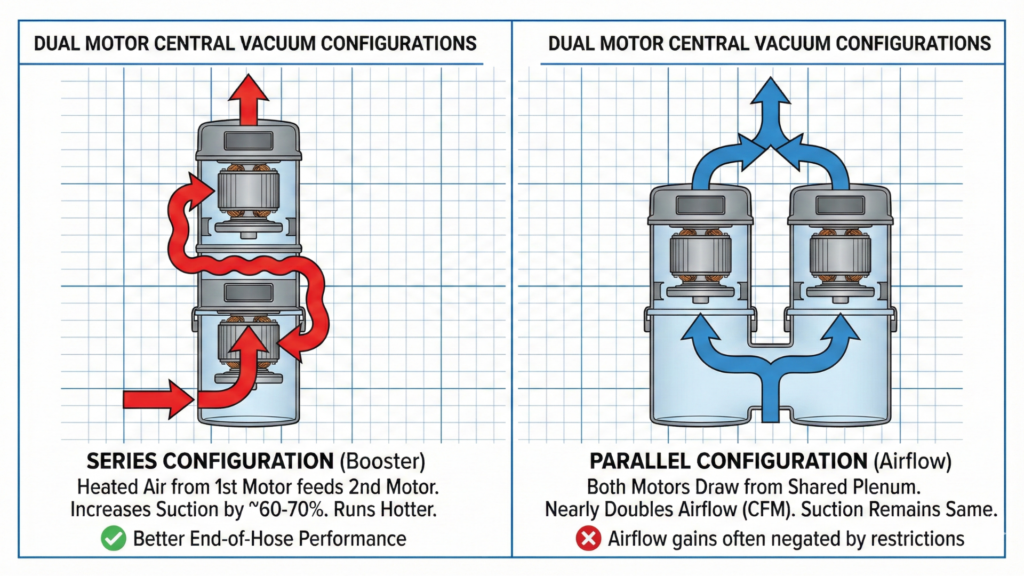
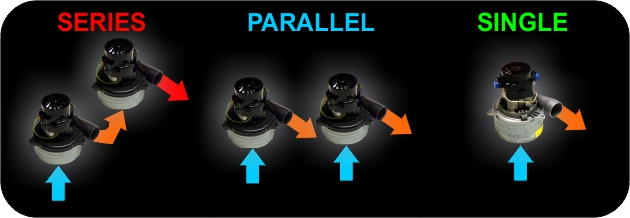
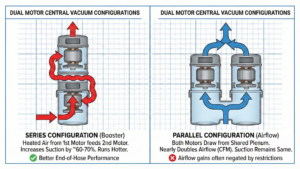
In a series configuration, one vacuum motor feeds its heated discharge air into the intake of the second motor. This effectively increases vacuum suction (inches of waterlift) by 60 to 70 percent while airflow remains roughly the same as a single motor.
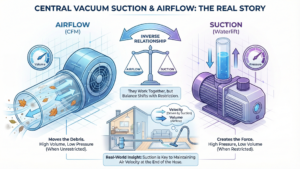
As we explained in our article on Suction and Airflow, suction is the dominant factor in end-of-hose performance. So a series dual motor central vacuum has a real engineering advantage — the extra suction translates directly into better cleaning power at the tool.
However, there’s a significant downside. The second motor is ingesting hot discharge air from the first motor, which means it operates at elevated temperatures. This reduces overall motor life expectancy. Extra care must also be taken to separate discharge air from cooling air, particularly with Thru-Flow and Peripheral Bypass motors.
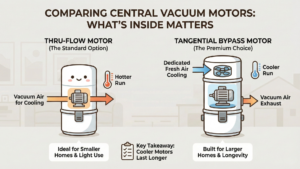
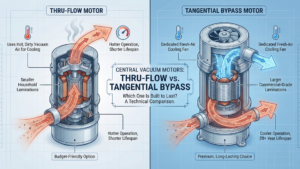
Tangential Bypass motors handle this configuration best because their design inherently keeps heated discharge air and cooling air separate.
Dual Motor Central Vacuum: Parallel Configuration
In a parallel configuration, both motors draw air from a shared plenum chamber. This has the effect of nearly doubling the airflow (CFM) while keeping suction (waterlift) comparable to a single motor.
On a spec sheet, a parallel dual motor central vacuum looks impressive. But here’s the problem demonstrated by real-world testing: those airflow gains are largely negated by the restrictions found in a typical central vacuum installation.
As Ametek/Lamb noted in a product review, when restrictive tools and hoses are used, the potential airflow advantages gained by a parallel arrangement may be entirely negated. The extra CFM generated by the second motor gets absorbed by the hose, plumbing, filter, and cleaning tool before it ever reaches the floor.
The Engineering Evidence: Series vs. Parallel
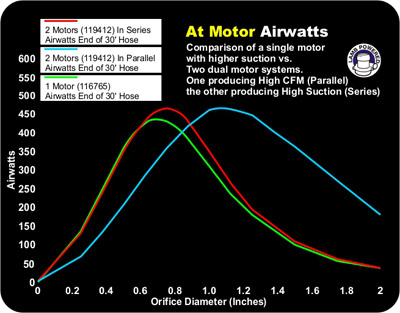
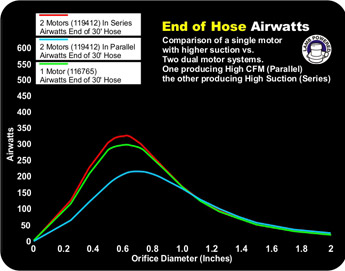
Ametek/Lamb engineers tested three configurations side by side, measuring actual end-of-hose airwatts through a 30-foot hose:
Single motor baseline — The control measurement.
Dual motor in series (boosted suction, same airflow) — Delivered the best end-of-hose performance, significantly outperforming both the baseline and the parallel configuration.
Dual motor in parallel (boosted airflow, same suction) — Delivered the worst end-of-hose performance, despite having nearly double the airflow at the motor.
The data is clear: in a real-world central vacuum installation, boosting suction is far more effective than boosting airflow. A parallel dual motor central vacuum may look powerful on paper, but it underdelivers where it counts — at the end of the hose.
When Does a Dual Motor Central Vacuum Make Sense?
For most homes — even large ones up to 10,000 square feet — a single high-quality Tangential Bypass motor with a fan diameter of 7.2 inches or greater is the best value. It delivers strong performance with fewer components to maintain and fewer potential points of failure.
A dual motor central vacuum becomes worth considering in these specific scenarios:
Your home is larger than 12,000 square feet. At this size, the plumbing runs become so long that even a powerful single motor struggles to deliver consistent performance to every inlet.
You want maximum possible performance. If budget is not the primary constraint, dual motors in a series configuration can deliver measurably better end-of-hose suction.
However, the recommended approach for very large homes is not a single dual motor central vacuum unit. Instead, install multiple high-performance single-motor units targeting separate zones — much like what’s done with HVAC systems in large homes or commercial buildings.
Each zone gets its own dedicated motor, its own inlet valves, and its own plumbing run. This eliminates the extreme plumbing lengths that degrade performance and ensures every zone receives strong suction. It’s more effective than trying to push more air through the same set of pipes.
The Bottom Line on Dual Motor Central Vacuums
Two motors aren’t automatically better than one. Configuration and motor quality matter enormously:
A parallel dual motor central vacuum doubles airflow but provides no suction gain — and testing shows those airflow gains evaporate through real-world restrictions. A series configuration boosts suction and delivers better end-of-hose results, but at the cost of higher temperatures and potentially shorter motor life.
For the vast majority of homes, a single large Tangential Bypass motor is the smartest investment. For very large properties, a zoned approach with multiple independent units is more effective than any dual-motor configuration.
Frequently Asked Questions About Dual Motor Central Vacuums
Is a dual motor central vacuum better than a single motor? Not necessarily. A dual motor system in parallel can actually perform worse at the end of the hose than a single high-quality motor. A series configuration improves suction but runs hotter, reducing motor life. For most homes, a single large Tangential Bypass motor is the better investment.
What is the difference between series and parallel central vacuum motors? Series motors feed one motor’s exhaust into the other, boosting suction by 60–70%. Parallel motors draw from a shared chamber, nearly doubling airflow. In real-world testing, the series configuration delivered significantly better end-of-hose performance.
What size home needs a dual motor central vacuum? Most homes up to 10,000 square feet are well served by a single high-quality Tangential Bypass motor. Dual motors or zoned systems become worth considering for homes over 12,000 square feet.
Why does a parallel dual motor system underperform? Because the doubled airflow is absorbed by the natural restrictions of hoses, plumbing, filters, and cleaning tools. Without a corresponding increase in suction, the extra airflow never reaches the end of the hose in a meaningful way.
What is the best setup for a very large home? Multiple independent single-motor units targeting separate zones, similar to a zoned HVAC system. Each zone gets its own motor and plumbing, eliminating the long runs that degrade performance.
When shopping for a central vacuum, most conversations focus on motors and performance numbers. But central vacuum filtration deserves just as much attention. Your filter
In our previous article on airwatts, we explained why the most popular vacuum performance metric is misleading. But if airwatts aren’t the right way to
If you’ve spent any time researching central vacuums, you’ve almost certainly come across the term “airwatts.” It’s the single most commonly cited performance metric in
Knowing the difference between Thru-Flow and Tangential Bypass motors is a great start — but comparing central vacuum motors properly means going deeper. Motor type
To provide the best experiences, we use technologies like cookies to store and/or access device information. Consenting to these technologies will allow us to process data such as browsing behavior or unique IDs on this site. Not consenting or withdrawing consent, may adversely affect certain features and functions.
Functional
Always active
The technical storage or access is strictly necessary for the legitimate purpose of enabling the use of a specific service explicitly requested by the subscriber or user, or for the sole purpose of carrying out the transmission of a communication over an electronic communications network.
Preferences
The technical storage or access is necessary for the legitimate purpose of storing preferences that are not requested by the subscriber or user.
Statistics
The technical storage or access that is used exclusively for statistical purposes.The technical storage or access that is used exclusively for anonymous statistical purposes. Without a subpoena, voluntary compliance on the part of your Internet Service Provider, or additional records from a third party, information stored or retrieved for this purpose alone cannot usually be used to identify you.
Marketing
The technical storage or access is required to create user profiles to send advertising, or to track the user on a website or across several websites for similar marketing purposes.