🚚 FREE SHIPPING on orders over $99•✓ 30-Day Money Back Guarantee•⭐ Serving Okanagan Since 1994•🚚 FREE SHIPPING on orders over $99•✓ 30-Day Money Back Guarantee•⭐ Kelowna's Favorite Vacuum Store since 1994
Central Vacuum Airwatts Explained: Why This Spec Is Misleading
If you’ve spent any time researching central vacuums, you’ve almost certainly come across the term “airwatts.” It’s the single most commonly cited performance metric in product brochures, comparison charts, and sales pitches. But central vacuum airwatts are also the single most misunderstood number in the entire industry — and relying on them can lead you straight to a worse purchasing decision.
This article breaks down what central vacuum airwatts actually measure, why the brochure numbers don’t reflect reality, and what you should evaluate instead.
What Are Central Vacuum Airwatts?
In principle, airwatts measure the performance “sweet spot” where suction and airflow are both at their best at a particular orifice size. The formula is straightforward:
It combines two different performance measurements — suction (inches of waterlift) and airflow (cubic feet per minute) — into a single number that represents motor efficiency at one specific point along its performance curve.
On the surface, this sounds like a useful comparison tool. The problem isn’t the formula itself — it’s how and where manufacturers take the measurement.
Why Brochure Central Vacuum Airwatts Don’t Reflect Reality
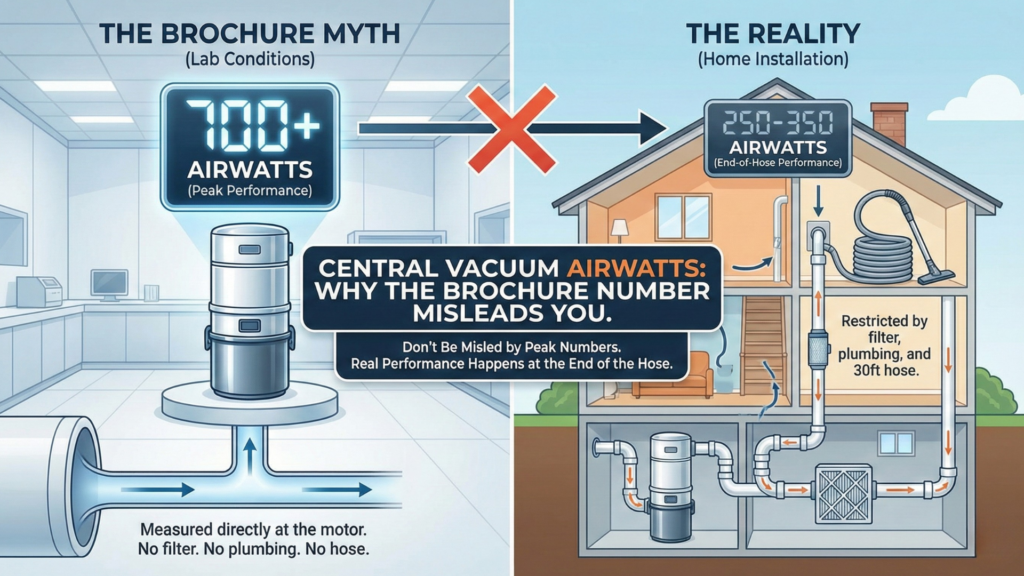
Manufacturers measure the airwatt number printed on a product brochure directly at the motor, under laboratory conditions, with zero restrictions in place. There’s no filter reducing airflow. PVC plumbing isn’t creating friction. The test omits a 30-foot hose entirely. And no cleaning tool sits at the end.
In a real home installation, your central vacuum has to push air through all of those things. Every one of them reduces performance from the peak number on the box. Central vacuum airwatts would only reflect true system performance if someone took the measurement at the end of the vacuum hose, in an actual installation, with typical restrictions in place.
But nobody does it that way — and the gap between brochure numbers and real-world performance is significant.
The Effective Working Orifice
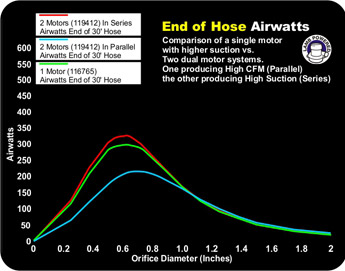
Engineers at Ametek/Lamb — one of the leading motor manufacturers in the industry — have studied this extensively. They determined that the “effective working orifice” of a typical central vacuum installation is approximately 5/8 of an inch (0.625 inches). This is the orifice at which the system actually operates when you factor in real-world restrictions like filters, plumbing, and hose length.
This effective orifice is much smaller than the point where manufacturers measure peak central vacuum airwatts. When you recalculate at this real-world point, the numbers change dramatically — and the rankings between motors can completely reverse.
A Tale of Two Motors: Why Central Vacuum Airwatts Mislead
Consider this comparison using actual Ametek/Lamb performance data:
Motor A — A 5.7-inch Thru-Flow two-stage motor. Peak airwatts (the brochure number): 700.
Motor B — A premium 8.4-inch Tangential Bypass single-stage motor, heavy-duty and commercial-rated. Peak airwatts: 717.
On paper, these two motors look nearly identical. Motor B has a slight edge, but nothing that would justify its significantly higher price if you’re shopping on central vacuum airwatts alone.
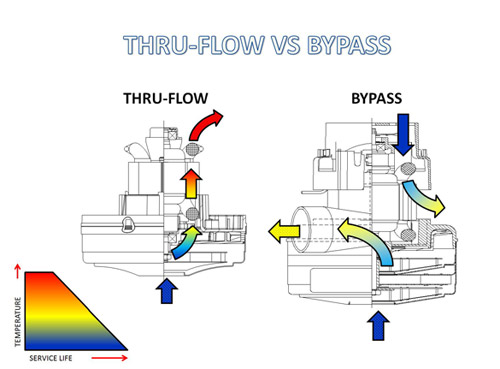
But at the effective working orifice, the story changes completely. The smaller, less expensive Thru-Flow motor can actually outperform the large, commercial-grade Tangential Bypass motor in raw airwatts — despite being fundamentally less robust, less durable, and shorter-lived.
This is precisely the trap. A tiny, inexpensive motor can post impressive central vacuum airwatts while being nowhere near as reliable as a premium motor that costs four times more.
What Central Vacuum Airwatts Don’t Tell You
The airwatt calculation doesn’t capture several things that matter enormously in practice:
Motor durability. A high airwatt number says nothing about how long the motor will last under real-world conditions. A Thru-Flow motor with high airwatts may burn out years before a Tangential Bypass motor with lower airwatts.
Heat management. Central vacuum airwatts don’t reflect how the motor handles heat, cooling, or thermal stress. These factors directly impact motor life and consistent performance over time.
End-of-hose performance. Manufacturers take the measurement at the motor, not at the end of a 30-foot hose with a cleaning tool attached. What matters is how much suction and airflow reach the floor.
Motor type and quality. Two motors with identical airwatt ratings can be vastly different in construction quality, component materials, cooling design, and expected service life.
What to Evaluate Instead of Central Vacuum Airwatts
If airwatts aren’t the answer, what should you look at? Three things matter far more:
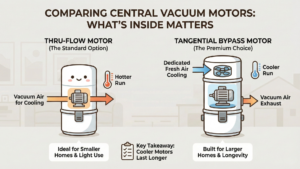
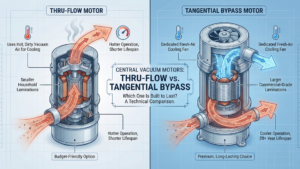
Motor type and size. A Tangential Bypass motor will outlast a Thru-Flow motor in demanding applications. Larger fan diameters indicate more robust motors. These factors serve as better indicators of value than any performance number. See our full guide to comparing central vacuum motors.
Sealed vacuum (suction potential). Higher sealed vacuum potential translates to better end-of-hose performance because suction overcomes the restrictions that eat away at airflow. We explain this in detail in our article on Suction and Airflow.
Powerhead quality. The electrical powerhead you choose for carpet cleaning has a greater impact on carpet cleaning performance than small differences in motor output at the end of the hose. Pairing a great motor with a mediocre powerhead will underperform compared to a good motor matched with an excellent powerhead.
The Bottom Line on Central Vacuum Airwatts
Central vacuum airwatts are the result of a mathematical equation that attempts to assign a single performance value to the relationship between suction and airflow. It’s not a useless number — but it becomes deeply misleading when you use it in isolation.
Less expensive Thru-Flow motors can match or exceed the airwatt ratings of larger, premium Tangential Bypass motors. The trade-off is service life, durability, and real-world end-of-hose performance. Don’t let a brochure number talk you out of a better motor.
If there’s one takeaway from this article, let it be this: always compare the motor, never base your decision on airwatts alone.
Frequently Asked Questions About Central Vacuum Airwatts
What are airwatts in a central vacuum? Airwatts represent a performance metric that multiplies suction by airflow at a specific orifice size and divides by 8.5. The number captures the theoretical efficiency sweet spot of a motor, but labs measure it under ideal conditions — not in real-world installations.
How many airwatts is good for a central vacuum? There is no magic airwatt number. Central vacuum airwatts measured at the motor don’t reflect end-of-hose performance. Instead of chasing a specific airwatt figure, compare motor type (Tangential Bypass vs. Thru-Flow), fan diameter, and sealed vacuum potential.
Are higher airwatts always better? No. A small, inexpensive Thru-Flow motor can post higher airwatts than a large, commercial-grade Tangential Bypass motor — despite being less durable and having a shorter lifespan. Airwatts alone do not indicate overall system quality.
What is the effective working orifice? It’s the orifice size at which a central vacuum actually operates under typical real-world conditions (with filter, plumbing, and hose restrictions). Ametek/Lamb engineers determined this to be approximately 5/8 of an inch — much smaller than the point where manufacturers measure peak airwatts.
Should I ignore airwatts completely? Not completely, but never use them as the primary basis for comparison. Treat central vacuum airwatts as one data point among several — motor type, motor size, sealed vacuum, and manufacturer quality are all more reliable indicators of long-term performance and value.
When shopping for a central vacuum, most conversations focus on motors and performance numbers. But central vacuum filtration deserves just as much attention. Your filter
In our previous article on airwatts, we explained why the most popular vacuum performance metric is misleading. But if airwatts aren’t the right way to
If you’ve spent any time researching central vacuums, you’ve almost certainly come across the term “airwatts.” It’s the single most commonly cited performance metric in
Knowing the difference between Thru-Flow and Tangential Bypass motors is a great start — but comparing central vacuum motors properly means going deeper. Motor type
To provide the best experiences, we use technologies like cookies to store and/or access device information. Consenting to these technologies will allow us to process data such as browsing behavior or unique IDs on this site. Not consenting or withdrawing consent, may adversely affect certain features and functions.
Functional
Always active
The technical storage or access is strictly necessary for the legitimate purpose of enabling the use of a specific service explicitly requested by the subscriber or user, or for the sole purpose of carrying out the transmission of a communication over an electronic communications network.
Preferences
The technical storage or access is necessary for the legitimate purpose of storing preferences that are not requested by the subscriber or user.
Statistics
The technical storage or access that is used exclusively for statistical purposes.The technical storage or access that is used exclusively for anonymous statistical purposes. Without a subpoena, voluntary compliance on the part of your Internet Service Provider, or additional records from a third party, information stored or retrieved for this purpose alone cannot usually be used to identify you.
Marketing
The technical storage or access is required to create user profiles to send advertising, or to track the user on a website or across several websites for similar marketing purposes.