🚚 FREE SHIPPING on orders over $99•✓ 30-Day Money Back Guarantee•⭐ Serving Okanagan Since 1994•🚚 FREE SHIPPING on orders over $99•✓ 30-Day Money Back Guarantee•⭐ Kelowna's Favorite Vacuum Store since 1994
Central Vacuum Buyer’s Guide 2026 | Motors, Airwatts, Filtration & More
Shopping for a central vacuum system is confusing — and this central vacuum buyer’s guide is here to fix that. Between exaggerated performance claims, misleading specifications like airwatts and CFM, and dozens of manufacturers all promising the best product, most homeowners don’t know where to start. We’ve put together this comprehensive guide to break down every major topic in plain language, so you can confidently choose the right system for your home, your budget, and your lifestyle.
What Is a Central Vacuum System?
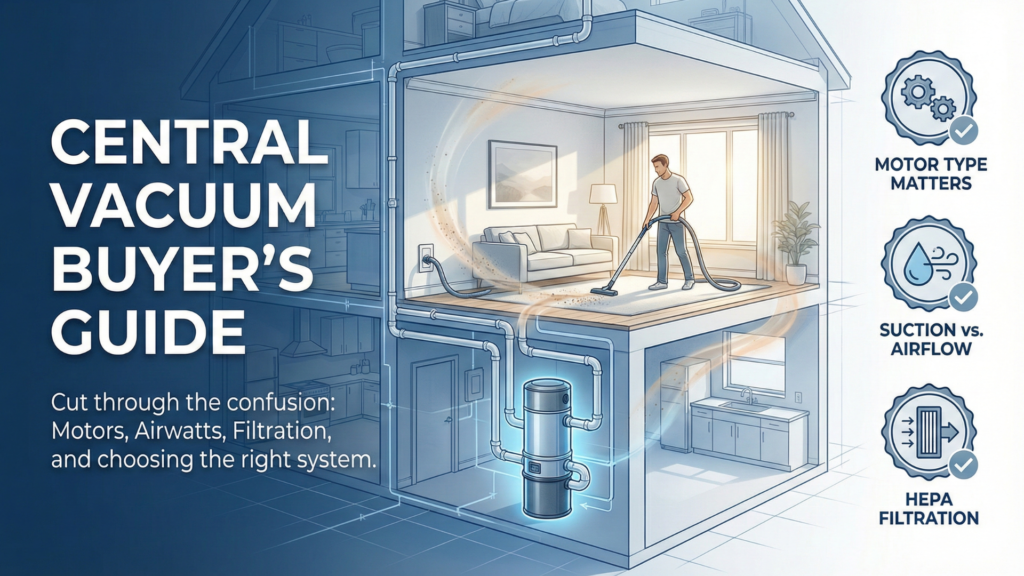
A central vacuum system is a built-in home cleaning appliance. Unlike portable vacuums that you push from room to room, a central vacuum uses a permanently installed motor and collection canister — typically mounted in a garage, basement, or utility room — connected to inlet valves throughout your home via PVC plumbing hidden inside the walls.
To vacuum, you plug a lightweight hose into the nearest inlet valve. Dirt and debris travel through the plumbing to the central canister, where it’s filtered and stored. Because the motor and exhaust are located away from your living space, central vacuums are quieter, more powerful, and clinically proven to improve indoor air quality by reducing allergens, dust mites, pet dander, and other airborne pollutants.
Central Vacuum Buyer’s Guide: Why the Motor Matters Most
The motor is the heart of every central vacuum system — and it’s what you’re really paying for. There are two main motor types, and understanding the difference is the single most important takeaway from this central vacuum buyer’s guide.
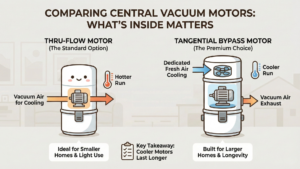
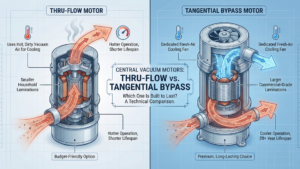
Thru-Flow motors are the more affordable option. They use the vacuumed air itself to cool the motor, meaning heated, filtered air passes directly over internal motor components. Thru-Flow motors often post high airwatt numbers and deliver solid cleaning performance for smaller homes, condos, or lighter-use scenarios. However, they run hotter, accumulate more internal wear, and typically have a shorter lifespan than their premium counterpart.
Tangential Bypass motors are the premium choice. These motors have a dedicated fresh-air cooling fan that operates independently from the vacuum airstream. Dirty air bypasses the motor’s internal components entirely, reducing heat buildup and contamination. Tangential Bypass motors use larger, commercial-grade laminations and actually run cooler under restriction — the opposite of how a Thru-Flow motor behaves. This engineering advantage translates directly into a longer service life and more reliable performance over time.
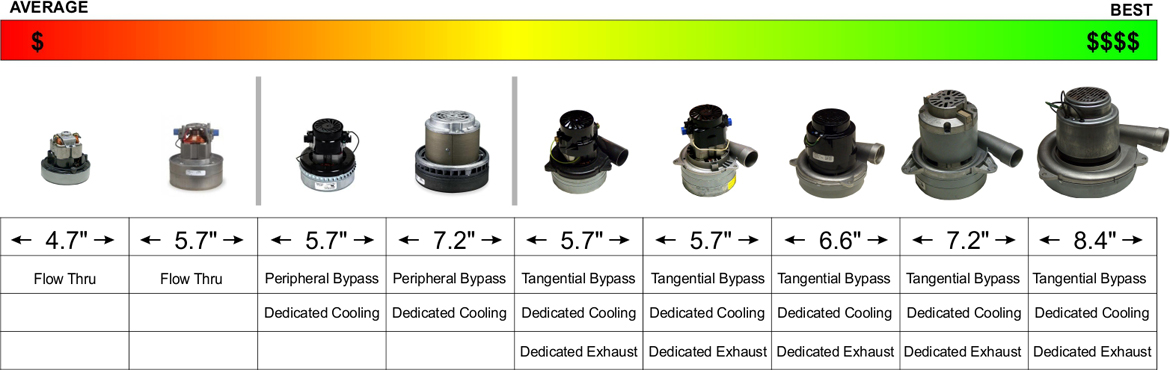
A large 8.4-inch Tangential Bypass motor can cost four times more than a comparable Thru-Flow motor, and that cost should be reflected in the retail price. If a manufacturer doesn’t disclose the motor type, it’s worth asking questions before you buy.
Motor type is only half the equation in any central vacuum buyer’s guide. Motor size, construction quality, and manufacturer all affect the true value of a system.
Motors are measured by fan diameter. Thru-Flow motors typically range from 4.7 to 5.7 inches, while Tangential Bypass motors are available up to 8.4 inches. Larger motors are built for heavier workloads in bigger homes.
When comparing two systems at similar price points, check both the motor type and the fan diameter. A system with a 5.7-inch Thru-Flow motor should cost significantly less than one with an 8.4-inch Tangential Bypass. If it doesn’t, you’re likely paying for the brand name rather than superior hardware.
Ametek/Lamb is widely regarded as the gold standard for central vacuum motors — they’re the only manufacturer producing an 8.4-inch motor and the only one with proprietary Infinity brush technology that extends carbon brush life.
Airwatts are the most commonly cited performance metric in central vacuum marketing — and the most misunderstood. Any thorough central vacuum buyer’s guide needs to address this head-on.
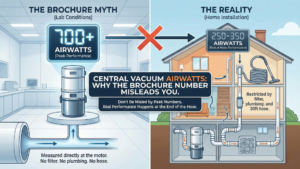
The airwatt number on a product brochure is measured directly at the motor under laboratory conditions, with no filter, no plumbing, no hose, and no cleaning tools attached. In a real home installation, every one of those elements reduces performance significantly.
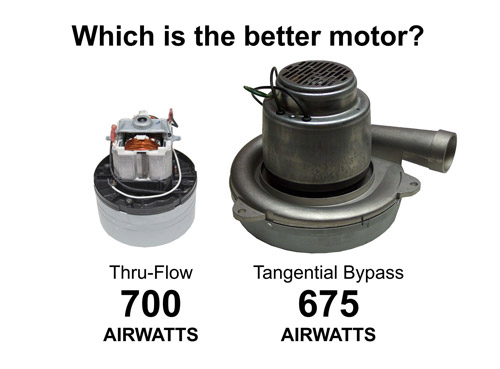
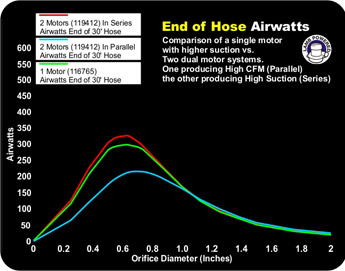
Industry engineers have determined that the effective working orifice of a typical installation is roughly 5/8 of an inch — far smaller than where peak airwatts are measured. At this real-world orifice, a small, inexpensive Thru-Flow motor can actually outperform a large, commercial-grade Tangential Bypass motor in raw airwatts. That doesn’t make it a better motor — it simply means airwatts fail to capture what matters most: durability, motor quality, and real-world end-of-hose cleaning performance.
The bottom line: Never base a buying decision on airwatts alone. Always compare motor type, motor size, and sealed vacuum potential.
Suction vs. Airflow: What This Central Vacuum Buyer’s Guide Recommends
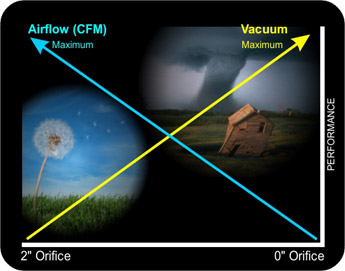
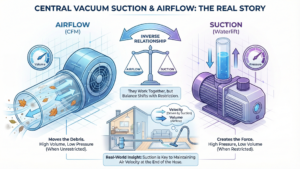
Every central vacuum operates on two forces: airflow (measured in CFM — cubic feet per minute) and suction (measured in inches of waterlift). Airflow moves debris through the system. Suction creates the pressure difference that makes that movement possible.
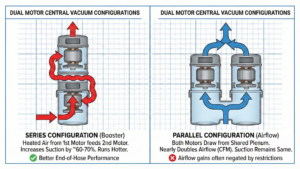
These two forces have an inverse relationship — when airflow is highest, suction is lowest, and vice versa. In real-world testing conducted by Ametek/Lamb engineers, suction proved to be the dominant factor in end-of-hose performance. A dual-motor system configured to boost airflow actually delivered the worst end-of-hose results, because the airflow gains were entirely consumed by the restrictions of the hose and plumbing. A system configured to boost suction delivered the best performance by a significant margin.
When evaluating systems, pay close attention to the sealed vacuum (waterlift) specification. Higher sealed vacuum means the motor can better overcome system restrictions and maintain strong cleaning performance where it actually matters — at the end of your hose.
Two motors sound better than one, but the configuration makes all the difference. A parallel dual-motor system nearly doubles airflow but doesn’t increase suction — and testing shows those airflow gains are negated by real-world restrictions. A series dual-motor system boosts suction significantly but runs hotter, potentially reducing motor life.
For most homes, a single high-quality Tangential Bypass motor with a fan diameter of 7.2 inches or greater offers the best balance of performance, longevity, and value. For very large homes over 12,000 square feet, a zoned approach with multiple independent units is more effective than any dual-motor configuration.
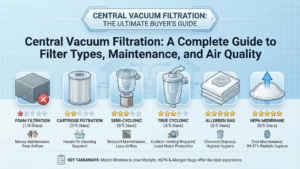
Your filtration system protects the motor from fine dust and determines the quality of air exhausted from the unit. Here’s a quick ranking of every major filtration type:
Foam filtration (1/5 stars) — Cheapest but least desirable; clogs quickly and requires messy hands-on cleaning.
Cartridge filtration (2/5 stars) — Better performance than foam but still demands periodic washing or replacement.
Semi-cyclonic (3/5 stars) — Combines cyclonic separation with a secondary filter, reducing maintenance frequency.
True cyclonic (3/5 stars) — Best unrestricted airflow, but least motor protection; must vent outdoors.
Allergen bag filtration (5/5 stars) — Modern multi-layer bags trap contaminants cleanly; just replace the bag when full.
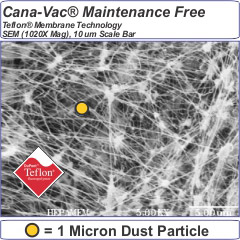
HEPA membrane filtration (5/5 stars) — The premium bagless option; captures 99.97% of particles at 0.3 microns with a non-stick coating that requires zero maintenance.
Central Vacuum Buyer’s Guide: Frequently Asked Questions
What is the best motor type for a central vacuum? Tangential Bypass motors are considered superior due to their dedicated cooling system, commercial-grade components, and longer service life. Thru-Flow motors are a viable budget option for smaller homes with lighter use.
How many airwatts do I need for a central vacuum? Airwatts alone are not a reliable indicator of real-world performance. Instead, compare motor type, motor size, and sealed vacuum (waterlift) to evaluate cleaning power in an actual installation.
How long does a central vacuum system last? A well-built system with a Tangential Bypass motor can last 20 years or more. Thru-Flow systems typically have a shorter lifespan, especially under heavy use in larger homes.
Do central vacuums help with allergies? Yes. Central vacuum systems have been clinically proven to reduce allergy symptoms by removing allergens from the living space rather than recirculating them.
What size central vacuum do I need? Match the motor to your home size and usage. Thru-Flow systems serve smaller homes and condos well. For homes over 3,000 square feet or households with pets and children, a Tangential Bypass motor with a fan diameter of 7.2 inches or greater is recommended.
This central vacuum buyer’s guide is the first article in our six-part series. Need help choosing the right system for your home? Contact our team — we’ve been helping homeowners find the perfect central vacuum since 1994.
When shopping for a central vacuum, most conversations focus on motors and performance numbers. But central vacuum filtration deserves just as much attention. Your filter
In our previous article on airwatts, we explained why the most popular vacuum performance metric is misleading. But if airwatts aren’t the right way to
If you’ve spent any time researching central vacuums, you’ve almost certainly come across the term “airwatts.” It’s the single most commonly cited performance metric in
Knowing the difference between Thru-Flow and Tangential Bypass motors is a great start — but comparing central vacuum motors properly means going deeper. Motor type
To provide the best experiences, we use technologies like cookies to store and/or access device information. Consenting to these technologies will allow us to process data such as browsing behavior or unique IDs on this site. Not consenting or withdrawing consent, may adversely affect certain features and functions.
Functional
Always active
The technical storage or access is strictly necessary for the legitimate purpose of enabling the use of a specific service explicitly requested by the subscriber or user, or for the sole purpose of carrying out the transmission of a communication over an electronic communications network.
Preferences
The technical storage or access is necessary for the legitimate purpose of storing preferences that are not requested by the subscriber or user.
Statistics
The technical storage or access that is used exclusively for statistical purposes.The technical storage or access that is used exclusively for anonymous statistical purposes. Without a subpoena, voluntary compliance on the part of your Internet Service Provider, or additional records from a third party, information stored or retrieved for this purpose alone cannot usually be used to identify you.
Marketing
The technical storage or access is required to create user profiles to send advertising, or to track the user on a website or across several websites for similar marketing purposes.