🚚 FREE SHIPPING on orders over $99•✓ 30-Day Money Back Guarantee•⭐ Serving Okanagan Since 1994•🚚 FREE SHIPPING on orders over $99•✓ 30-Day Money Back Guarantee•⭐ Kelowna's Favorite Vacuum Store since 1994
Comparing Central Vacuum Motors: Size, Anatomy, and Manufacturer Quality
Knowing the difference between Thru-Flow and Tangential Bypass motors is a great start — but comparing central vacuum motors properly means going deeper. Motor type is only half the equation. The fan diameter, internal construction, and the company that manufactured the motor all play a major role in the true value of any central vacuum system.
This article gives you the knowledge to make genuine apples-to-apples comparisons when shopping.
Does Motor Size Matter When Comparing Central Vacuum Motors?
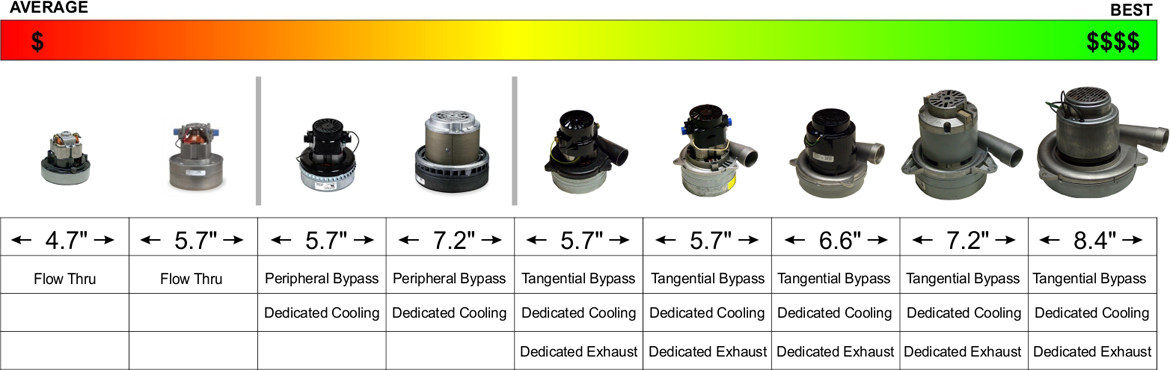
Absolutely. Central vacuum motors come in a range of sizes measured by fan diameter. Thru-Flow motors typically range from 4.7 to 5.7 inches, while Tangential Bypass motors are available in sizes up to 8.4 inches — a substantial difference in both physical size and engineering capability.
Larger motors are designed for heavier workloads and longer operating periods. A 12,000-square-foot home demands significantly more vacuuming time than a 2,000-square-foot condo, and that sustained use requires a motor built to handle it. Larger motors achieve this through more robust components, bigger laminations, larger fans, and greater thermal tolerance.
When comparing central vacuum motors at similar retail prices, always check two things: the motor type (Thru-Flow vs. Tangential Bypass) and the fan diameter. These two data points reveal the true value behind the price tag. A system with a 5.7-inch Thru-Flow motor should cost significantly less than one housing an 8.4-inch Tangential Bypass — if it doesn’t, you’re likely paying a premium for the brand name rather than the hardware.
Motor Anatomy: Understanding What’s Inside
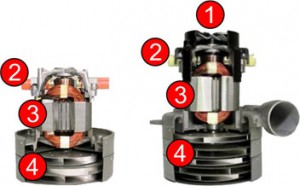
When comparing central vacuum motors, it helps to understand the basic internal components. Here are the key parts found in both major motor types:
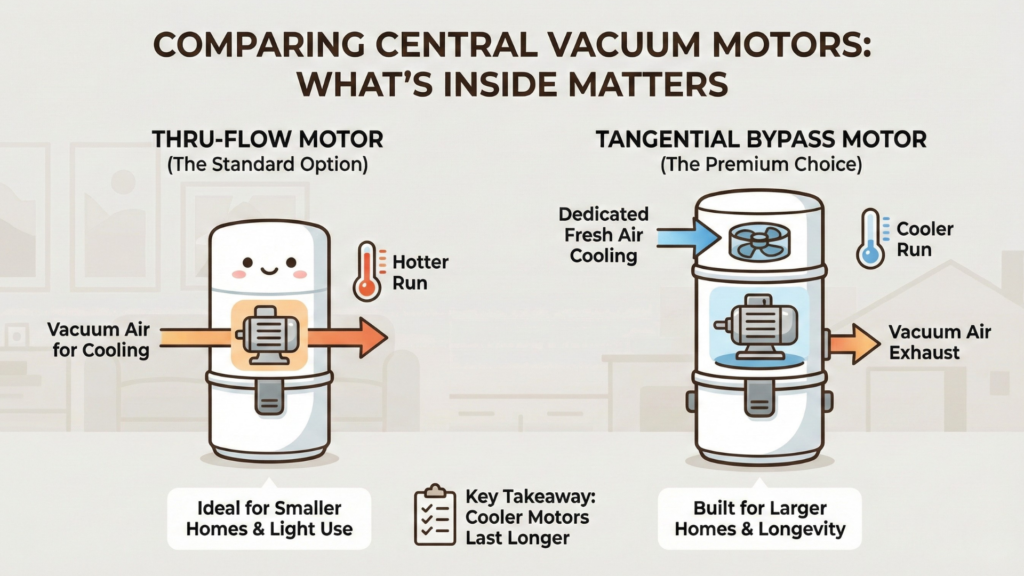
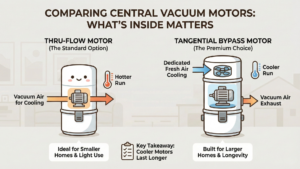
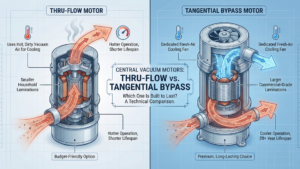
Motor Cooling Fan — This is the defining feature that separates a Tangential Bypass motor from a Thru-Flow. The cooling fan sits on top of the Tangential Bypass motor and draws in fresh, room-temperature air to cool the armature. Thru-Flow motors lack a dedicated cooling fan entirely — they rely on the vacuumed air itself for cooling.
Motor Carbon Brushes — These electrical contacts transfer current to the spinning armature. Carbon brushes wear over time and are one of the primary components that determine motor lifespan. Premium motors from Ametek/Lamb feature Infinity brush technology specifically designed to extend brush life.
Field Laminations and Armature — The laminations are stacked metal layers forming the motor’s electromagnetic core. Thru-Flow motors use smaller, household-rated laminations, while Tangential Bypass motors use larger, commercial-grade laminations with superior heat and stress tolerance. A 5.7-inch Tangential motor uses 3-inch commercial-grade laminations, with even larger ones on 7.2-inch and 8.4-inch models.
Fans (Stages) — Vacuum fans are stacked on the motor shaft, and the number of fans determines the motor’s “stages.” A two-stage motor has two fans; a three-stage has three. More stages generally increase suction capability, though motor type and diameter remain equally important factors when comparing central vacuum motors overall.
The Peripheral Bypass Motor: A Third Option
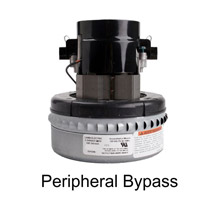
Beyond Thru-Flow and Tangential Bypass, there’s a less common third type worth knowing about when comparing central vacuum motors: the Peripheral Bypass motor.
Peripheral Bypass motors share the same fundamental advantages as Tangential Bypass motors. They have a dedicated cooling system that’s separate from the vacuumed air, giving them a similar improvement in life expectancy compared to Thru-Flow designs.
The key difference is how each handles exhaust air:
A Tangential Bypass motor uses a horn connected to PVC plumbing and a muffler, venting heated exhaust air away from the motor chamber and out of your living space entirely.
A Peripheral Bypass motor vents exhaust air around the motor itself, keeping it within the motor chamber.
For most homeowners, the Tangential Bypass is the preferred choice precisely because it removes heated, contaminated exhaust from the motor area. This keeps the motor compartment cleaner and allows the exhaust to be directed away from your living environment — an important consideration for indoor air quality.
Why the Motor Manufacturer Matters
Just as a Briggs & Stratton engine instills confidence in a lawnmower, the brand behind your central vacuum motor is a reliable quality signal.
Ametek/Lamb is widely regarded as the gold standard for central vacuum motors. They are the only manufacturer that produces an 8.4-inch diameter motor, and the only one with a 6.6-inch diameter option. Their premium motors feature proprietary Infinity brush technology, which extends the life of the motor’s carbon brushes — a meaningful advantage for long-term durability.
Ametek/Lamb’s engineering data is widely referenced across the central vacuum industry, including the performance experiments discussed in our articles on Airwatts and Suction and Airflow.
Domel is another well-regarded motor manufacturer and a popular choice among several central vacuum brands.
When comparing central vacuum motors across brands, always ask who manufactured the motor inside. A quality motor from a reputable manufacturer is one of the strongest indicators that the system as a whole has been built to last.
Comparing Central Vacuum Motors: A Practical Checklist
When you’re standing in a showroom or browsing online, here’s what to ask or look for:
What type of motor is it? Thru-Flow, Tangential Bypass, or Peripheral Bypass? If the answer isn’t readily available, ask — or assume it’s the less expensive Thru-Flow option.
What’s the fan diameter? Larger is generally better for heavier use, but it should also be reflected in the price.
Who manufactured the motor? Ametek/Lamb is the industry benchmark. If it’s a different manufacturer, research their reputation and track record.
How many stages? Two-stage and three-stage motors are common. More stages can improve suction, but motor type and size are equally important.
Does the price reflect what’s inside? This is the most important question. Armed with motor type, size, and manufacturer, you can now evaluate whether a system’s retail price is justified — or whether you’re paying for branding wrapped around a budget motor.
Frequently Asked Questions About Comparing Central Vacuum Motors
What size central vacuum motor do I need? For homes under 3,000 square feet with light use, a 5.7-inch motor is often sufficient. For larger homes or heavy use with pets and children, look for a 7.2-inch or 8.4-inch Tangential Bypass motor for maximum durability.
What is a Peripheral Bypass motor? A Peripheral Bypass motor is a third motor type that shares the cooling advantages of a Tangential Bypass but vents exhaust air around the motor rather than away from it. It’s less common but performs well when properly installed.
Who makes the best central vacuum motors? Ametek/Lamb is the most respected motor manufacturer in the industry, producing the widest range of sizes and the only 8.4-inch motor available. Domel is another reputable manufacturer used by several brands.
Does the number of motor stages matter? Yes, but it’s one factor among several. More stages generally mean more suction, but motor type (Tangential Bypass vs. Thru-Flow) and fan diameter have an equal or greater impact on overall performance and longevity.
How can I tell what motor is inside a central vacuum? Ask the retailer or manufacturer directly. If they won’t disclose the motor type, size, or manufacturer, consider it a red flag. Reputable brands are transparent about their motor specifications.
When shopping for a central vacuum, most conversations focus on motors and performance numbers. But central vacuum filtration deserves just as much attention. Your filter
In our previous article on airwatts, we explained why the most popular vacuum performance metric is misleading. But if airwatts aren’t the right way to
If you’ve spent any time researching central vacuums, you’ve almost certainly come across the term “airwatts.” It’s the single most commonly cited performance metric in
Knowing the difference between Thru-Flow and Tangential Bypass motors is a great start — but comparing central vacuum motors properly means going deeper. Motor type